The ALIA Board endorsed a significant research project to investigate and support the library and information services workforce. The aim of the initiative was to support a resilient, diverse workforce, to attract and develop talented, committed individuals from different cultural backgrounds, with the strength and agility to navigate a rapidly changing workplace. Crucial to the project was the acknowledgement that Aboriginal and Torres Strait Islander people’s library and information needs are better represented in the profession, and that workforce development has a part to play in this goal. The project encompassed the entire sector, spanned several years, and was overseen by an appointed Advisory Board.
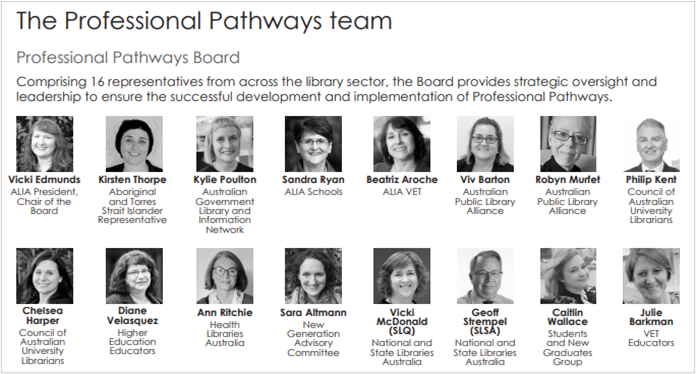


The project was initially known as the Professional Pathways Project, and was later renamed the Library and Information Services Workforce Project, with multiple strands and outputs. This was one of the largest investments in the LIS workforce made by ALIA. Likewise, the project benefited from significant input from members of the sector, with over 600 people giving their time and expertise to participate in consultations and workshops, provide feedback through surveys, and otherwise support the project.

The Board overseeing the project made four principle recommendations. The largest of these was to create a framework of knowledge, skills and ethical behavior as a sector-wide, whole-of-career resource to guide and support professional learning and development – see the Framework below.


Technical Support and Overview

The foundational piece of research for this project was the Technical Report (2022) written by Dr Gillian Hallam. The report presents detailed findings from a major literature review and environmental scan which focus on skills frameworks (LIS and from other professions), professional ethics and values, qualification pathways, future views of education and training, continuous professional development and professional status.

The project was timely, with governments, employers, educators and workers (current and future) all aware of the need to change the traditional model of education for and training in the professions to drive excellence and currency among professionals. A new mindset of life-long active professionalism, based on core ethics and values and with support for whole-of-career development, is what support libraries and information services to grow and develop in line with advances in society and technologies.

Five major themes are examined: the required knowledge and skills for library and information professionals, the values and ethics that underpin professional practice, the current qualification pathways into the profession, the role of micro-credentials in professional pathways, and the value of continuing professional development for professional recognition. Read the Technical Report here

Dr Gillian Hallam condensed the comprehensive findings of the complete Technical Report into a 50-page Overview Report. Read the Technical Report Overview here


School Libraries Research Project Report

As part of the broader initiative, ALIA commissioned research by Dr Lyn Hay to address the specialised needs of school libraries and ensure that skillsets of library and information professionals working in school libraries are appropriately differentiated.

The School Libraries Research Project Report addresses the nature and demographics of employee groups in Australian school libraries; existing qualifications and education pathways; the knowledge, skills, and competencies required of school library employees; ethics and professionalism within the context of school libraries; and continuing professional development. It concludes with a summary of key findings and a set of five recommendations. Read the School Libraries Research Project Report here.


Sector Consultation

In tandem with and following these reports, a series of extensive consultation activities were undertaken by ALIA as part of the project. These included online and in-person focus groups and workshops in all states and territories, during which participants gave input into the development of the knowledge, skills and ethics framework. The expertise and guidance of the ALIA Aboriginal and Torres Strait Islander Expert Advisory Group was significant in this phase.

You can read more about the consultation activities in the Professional Pathways Consultation Report, and the Professional Pathways Focus Groups Consultation Report.  


Outputs

The major output of this workforce initiative is the ALIA Skills, Knowledge and Ethics Framework for the Library and Information Services Workforce. This was developed with comprehensive input from the sector over a long period of time. At the heart of this Framework and project are the information needs of the communities served by the LIS workforce. The professional knowledge, ethics and values that are developed and put into practice underpin the diverse services that the sector offers these communities.


Another key output is the ALIA Code of Ethics for the Library and Information Services Workforce. We heard through the extensive consultation activities that despite the daily work tasks of people working in different sectors might be very diverse across the sector, what unites us is our shared ethics and values. However, Australia had never had its own Code of Ethics, instead pointing to and endorsing the IFLA Code of Ethics. The lack of a Code of Ethics specific to this country, context and population was seen as a lack, and ALIA undertook to consult with the sector to develop one.

The ALIA Continuing Professional Development Scheme has also been redesigned to align with the Framework, and work is ongoing to ensure that all events and training options are similarly aligned to the Framework.


For more information about the Framework, Code of Ethics or broader workforce research, contact [email protected].